
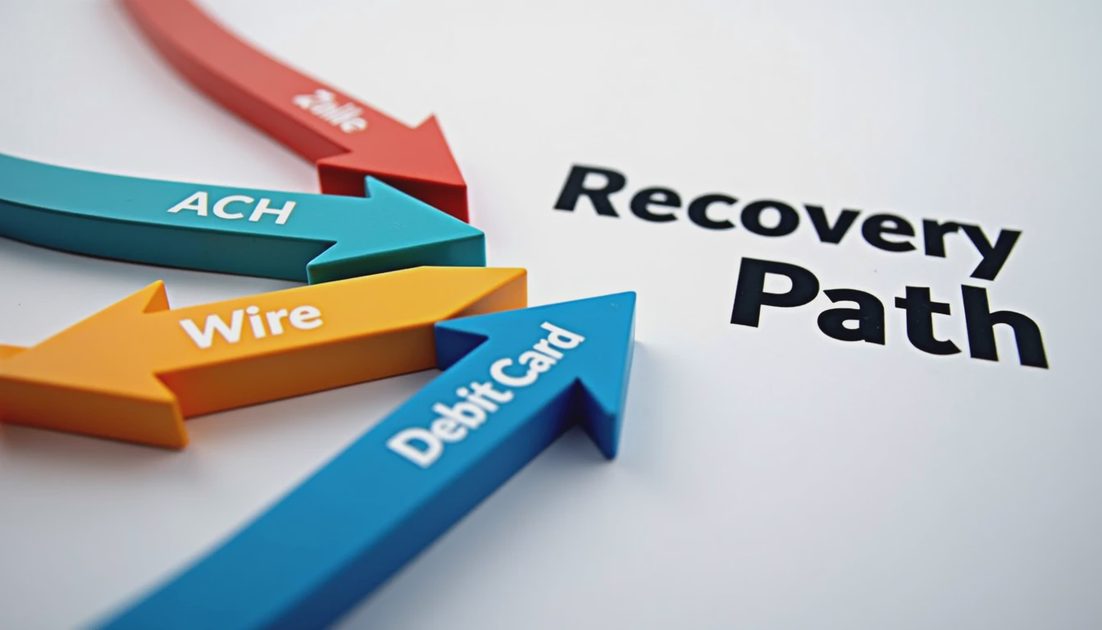
Not every unauthorized payment travels the same road.
Zelle, ACH, wire transfers, and debit-card charges look similar on a statement line. They are not similar once you try to reverse them.
Understanding which rail moved the money helps you ask the right questions, meet the right deadlines, and avoid waiting on a process that does not apply. This article is a practical map, not a promise of recovery.
I have sat with family members while a bank representative explained that an instant payment had already settled and that the recovery options were different from a regular card charge. The surprise on their faces is why this distinction belongs near the front of any money-in-motion guide. Speed of the original payment often works against speed of the recovery.
The Four Rails in Plain English
Debit-card transactions usually run through card networks. Consumer protections and provisional-credit rules often differ from bank-transfer rules.
ACH transfers move between bank accounts on a delayed batch system. Once settled, reversal options narrow quickly.
Zelle and similar instant payment services are designed for speed between enrolled users. Speed is the feature; easy reversal is not.
Wire transfers are high-speed, high-finality movements. After a wire leaves, recovery is often the hardest of the four.

What Changes for the Person Trying to Recover Funds
Rail | Speed of movement | Typical first call target | Reversal difficulty (general) | Extra urgency notes |
|---|---|---|---|---|
Debit card | Fast | Card issuer / bank fraud line | Moderate to high | Freeze card immediately |
ACH | Days | Bank that holds your account | Time-sensitive | Act as soon as you see it |
Zelle-style | Minutes | Your bank + the Zelle process | High | Instant nature limits options |
Wire | Hours or less | Sending bank | Very high | Often treated as final once sent |
These are general patterns, not guarantees. Your bank’s specific policies, the exact product, and whether the other side cooperates all matter.
Questions to Ask No Matter Which Rail
When you call, get answers to:
Which payment rail was used for this exact transaction?
What is the reference or investigation number?
What is the deadline for me to submit any written statement or additional evidence?
Will you issue a provisional credit while you investigate, and under what conditions can it be reversed?
Do I need to file a police report or an identity-theft report for your process?
Write the answers down before you end the call. If the representative does not know the rail, ask them to look it up or transfer you to someone who can. A vague “electronic payment” answer is not specific enough when Zelle, ACH, and wires follow different internal desks.

Practical Sequencing When You Are Unsure
Freeze or lock the card and online access first.
Call the official number on your statement or card and report the transaction as unauthorized.
Ask which rail the payment used if the statement is unclear.
Follow the specific instructions the bank gives for that rail.
Document everything in one dated folder.
Do not wait to “see if it bounces back.” Instant and near-instant rails rarely bounce back on their own. If the bank’s automated system or first representative cannot identify the rail, ask to be transferred to the fraud or claims department that handles electronic transfers. The extra transfer is worth it when the category determines the deadline.
When Multiple Rails Appear in One Incident
Attackers sometimes test a small debit-card charge and later attempt an ACH or Zelle transfer. Treat each transaction as its own report with its own reference number, even if they feel like one event. The recovery rules can differ by rail even inside the same overall crime.
Keep a single master timeline that lists every transaction, the rail if known, the time you reported it, and the reference number. That master list becomes the document you hand to a supervisor, a regulator, or a police officer later. Without it, the incident turns into a fog of separate phone calls.
Limits of This Guide
This is consumer education based on common patterns and personal experience helping family members. It is not legal, financial, or banking advice. Rules change, and your bank’s contract and federal regulations control the actual outcome. When the amount is large or the facts are complex, consider speaking with a qualified professional or your state consumer-protection resources after you have completed the immediate freeze-and-report steps.
Also remember that the other party’s bank or the payment network may need to be involved. Your ability to force that involvement is limited. What you can control is how quickly you report, how clearly you document, and how consistently you follow up with reference numbers in hand.
Stop the damage. Save the proof. Take the next step.
The next article covers exactly what I would write down before calling any fraud department so the conversation stays focused and the record stays useful. Knowing the rail helps you ask better questions; the written notes help you remember the answers. Together they turn a frightening statement line into a manageable set of next actions. Start with the freeze, then identify the rail, then follow the path that actually applies.
No comments yet.